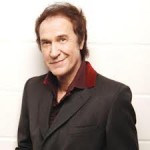
On being boycotted

A reader (John) disliked my recent post about the Trayvon Martin case, saying that my summaries are missing some key points.  ‘Ugh,’ he begins!  He says he enjoyed Dark Eden but doubts if he’ll read any of my other books, and he advises me to keep my opinions to myself:

I have never understand why athletes, public figures and those that depend on the support of a broad audience interject their political/cultural opinions into the public arena.  They just anger 50% of people who may otherwise purchase their product.

Two things about this I found a bit depressing.

Firstly, the idea that I should conceal my views on politics and culture in order to get people to ‘purchase my product’, particularly since my ‘product’ itself deals with politics and culture.  I find that a bit ‘ugh.’

Secondly, the idea that we should avoid the work of writers whose political or cultural views we disagree with.  A book that hugely impressed me when I first read it as a teenager was Robert Heinlein’s The Moon is a Harsh Mistress, the book about a libertarian lunar society whose motto was TANSTAAFL (There ain’t no such thing as a free lunch).  I didn’t agree then, and I don’t now, with Heinlein’s Tea Partyish politics, but it didn’t stop me appreciating, and wanting to emulate, the brilliance of the world-building.

One of the first accolades I received for Dark Eden was the book being selected as the ‘Big Read’ for the Greenbelt festival, and being asked to go there and give a talk about it.  This is a Christian festival, and I made no secret of the fact that I am not a Christian, but people were still interested in what I had to say about the Eden story, even though it obviously meant very different things to them than it does to me.  And God bless them for it!

*   *   *

In fairness to John, though, when I look back at my post, I can see it is unbalanced.   Clearly there was some kind of fight or scuffle between Trayvon and the man who shot him, and I can see that, given the bizarre context of a country where it is okay to carry a gun, it is possible to argue that self-defence was a factor in the shooting.

But why not also, then, in the case of Marissa Alexander, who fired a shot which didn’t even hit anyone?  Of course I don’t know the detail of the cases, but I find it hard to imagine any additional detail that would justify a twenty year sentence in the latter case, if a complete acquittal was justified in the former.

There are many studies that show how, in predominantly white societies, the behaviour of black people is much more negatively connoted than the same behaviour by white people.  Look at this video which compares the reactions of passers-by to a young white man who appears to be stealing a bike, and then to a young black man doing exactly the same.
Birth of a new book

I’ve just completed the first draft of the first short chapter of my new novel Slaymaker.  It’s only a couple of thousand words, which probably doesn’t sound much, but it’s the result of several frustrating unfocussed inspirationless days of faffing around.

And here’s the best thing.  It’s finally coming alive.  There’s energy in it.  There’s the beginnings of a new way of telling the story, a new kind of narrative voice, that’s unique to and necessary to this particular book.  And then there’s Slaymaker himself, appearing for the first time at the end of the chapter, rather as  a singer walks out onto the stage at the very end of the warm-up number played by his backing group.

Of course this energy will go again, of course they’ll be many more days when it feels like nothing will come alive at all.   But now I’ve found it once, I know I’ll find it again

Morocco

I spent the week before last in a place on the coast of Morocco called Oued Laou with two old friends, Clive and Jonathan.  Jonathan has a small house there and speaks Moroccan Arabic, which earns him huge respect.

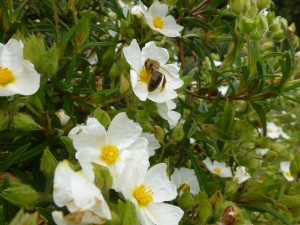
The last time I visited him there, the trip inspired my story The Peacock Cloak.  On the hills around the town, cistus flowers, admired by Tawus at the beginning of the story, grow in great profusion.

P1020658

Much of the ground, though, is intensively cultivated by small subsistence farmers who grow wheat, barley, peas, lentils, onions and figs, all packed in tightly together, and keep goats, sheep, cows and chickens.

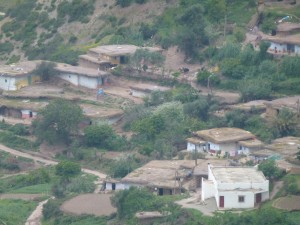
They live in very small and simple single-storey houses consisting of a brick wall, topped with flat layers layer of branches and twigs, and then a covering of loose earth (though some of them now have added a polythene membrane, a solar panel, or even a power line).  As I looked out at the little hillside village below I imagined people living pretty much as they do now in houses pretty much like these for thousands of years, while successive invaders – Romans, Vandals, Arabs, Spaniards – broke over them like waves with their various projects of subjugation/improvement/religious conversion/enlightenment/ modernisation.  Just like Tawus.

P1020765

And like Tawus too, we found ourselves to be the objects of fascination and even wonder.  One old woman stood with her hand over her mouth as if to stifle shrieks of incredulity, while her more confident daughter questioned us sharply about ourselves.  Where did we come from, France or Spain?  (There were only two options, I understand.)

They insisted we came in for mint tea and fried eggs.  The goat wandered in after us and settled down comfortably in a corner of the bare earth floor.   The daughter looked across at it and drew a finger over her throat to indicate the goat’s fate after Ramadan, telling us of the many uses to which its meat and skin would be put.

The tea was like polo mints dissolved in water.  The eggs were delicious too.

Science Fiction

I attended a seminar on an  SF  module, led by my friend Prof Rowlie Wymer.   Rowlie was describing a particular SF short story.  I forget which story it was, but it had all the virtues that are the hallmarks of good SF, a certain kind of disciplined playfulness.   And the thought came to me that ‘science fiction’ is correctly named, not because it necessarily deals  with science, but because of a certain similarity between its methodology, its creative strategy, and the scientific method.  You take the world as we know it, you manipulate certain variables, you see what happens, you explore the implications. As another professor, Ian Stewart, said at the Clarke award event, science fiction is about ‘what if’.

Waterloo Sunset

I very much enjoyed this programme about Ray Davies. I was struck by his comment about one of his songs (I think it was ‘Days’) that the words might seem ‘a bit naff’ on their own, but he felt that the music transformed them.   Actually that is true, I think, of quite a bit of his stuff.   People usually praise the words, the little observations and stories, but on their own the observations are not necessarily all that original.  There are a lot of songs, for instance, about the fears and longings of suburban life (‘Mr Pleasant’ or ‘Shangri-la’) which, taken just as stories and observations, are amusing but quite commonplace.  But the music really does transform them into something else.

In fact I’d say his musical inventiveness is, if anything, rather underrated, or at any rate not so often remarked on.  His back catalogue of songs (imagine having written ‘You Really Got Me’, ‘Days’, ‘Sunny Afternoon’, ‘Autumn Almanac’, ‘Lola’ and ‘Waterloo Sunset’!) is quite exceptionally varied in terms of moods, rhythms and musical colours, and is full of lovely details and surprises.  Listen, for instance, to the way that the strange and melancholy ‘See My Friends’ changes its feel and rhythm in the middle of each verse, opening up after ‘now there’s no-one there’, and then drawing back again.

For various reasons, although I grew up in the 60s and 70s, I didn’t encounter ‘Waterloo Sunset’ at all until about 5 years after it came out.  But when I did finally come across it I was really blown away, and I still am.   It really is the most amazing marriage of words and music.  There is actually not one single word of description of the sunset itself, yet when I listen to this song, the harmonies rising up over the melody instantly evoke to me an enormous brightly coloured sky, towering up over the little figures of Terry and Julie, and the people swarming out of the underground, and the song’s narrator, watching the whole scene from his window.

(As I’ve observed before, vivid descriptive writing isn’t so much a matter of providing detailed instructions of a scene, as of giving readers/listeners permission to construct the scene for themselves.  This is a perfect example.  We all know what sunsets look like, and don’t need to be told, but we do need something to trigger off the whole set of associations, something to allow us to pretend that a sunset is happening right now.)

The Glastonbury version of the song here is performed with the Crouch End Chorus, which includes my good friend Clive among its tenors.  Lucky man.

(Clive lives in North London, where Davies grew up and still lives, very much in the surroundings in which the programme is filmed.  The programme reminded a bit too of an odd but interesting book by another North Londoner that I wrote about here.)

YA?

Genre labelling can be annoying.  I have more than once moaned here about the fact that a lot of people won’t touch my books, simply because they are ‘science fiction’.   Another genre label that I’ve seen applied several times recently to Dark Eden is ‘YA’.  (According to Wikipedia: “Young-adult fiction or young adult literature (often abbreviated as YA), also juvenile fiction, is fiction written, published, or marketed to adolescents and young adults”.)

Well, the book is certainly primarily about young adults – the two main narrators/protagonists of this book are both (in Earth terms) in their teens – and I’m very pleased and proud to hear that teenagers and young adults are enjoying the book.  But I didn’t write the book for teenagers or young adults, or for middle-aged adults or indeed for any specific demographic group.   I try to write books and stories that I’d like to read.  And personally I don’t seek out stories with characters of my own age and background (how dull that would be), or stories aimed at my own age group.

The assumption behind labelling Dark Eden as YA seems to be that, because a book is about a certain type of person, it must therefore be written specifically for that type of person.  It’s an assumption you can often also see being made in the way that individual books are marketed.  (For example, ‘This is a book for anyone who has ever loved and lost’).

Well, I suppose one reason for reading a book is to look for role models and validation, people you can identify with, people who will confirm that it’s okay to be the person you are, but it would be rather limiting if that was the only reason we read books.  And unhealthy and atomising too.  (Do we want each age group and each gender to occupy its own separate little cultural bubble?)   The point of reading fiction is surely to imaginatively experience lives that are different from your own, not just to look into a mirror and see some sort of idealised version of yourself.

Dark Eden seems to appeal to a lot of different people, men, women, young, old, atheists, Christians… etc etc.   And that’s exactly what I wanted it to do.

The secret sea

‘The Caramel Forest’ and ‘Day 29’ are both set in the forests of the planet Lutania.

This imagined place owes a lot to the Strugatsky brothers’ The Snail on the Slope, which also describes a strange forest where human inhabitants live among strange alien life forms, while a scientific agency sits on a cliff above.  Stanislaw Lem’s Solaris has a similar set-up of human scientists hovering above a weird, utterly inscrutable, living ocean, and the ‘castle’ in ‘The Caramel Forest’ was suggested to me by the inexplicable structures that emerged from time to time from the seething surface of Solaris.

Both Solaris and Snail on the Slope are books that refuse to resolve themselves.  One way of looking at this is to say that such books deny the reader the pleasure of tied-up loose ends.  But you could equally well say that they refuse to snatch back from the reader an encounter with the alien. Tidy endings can be acts of vandalism.

‘Hansel and Gretel’ is in the mix here too of course, along with all the other sinister/enticing forests in fairy tales. (Laura Diehl, who did the illustration of ‘The Caramel Forest’ for the Asimov’s cover is primarily a children’s book illustrator.  A great choice.)  So, I think, is a stoned and dreamy LP by a jazz-tinged 1970s prog-rock band called Caravan, whose title track began:

In the land of grey and pink where only boy-scouts stop to think
They’ll be coming back again, those nasty grumbly grimblies
And they’re climbing down your chimney, yes they’re trying to get in
Come to take your money – isn’t it a sin, they’re so thin?

*  *  *

The ‘goblins’ in Lutania are able to stir things up in people’s minds.  For most people, this is unwelcome.  They are forced to think about painful or scary things that they’ve tried to bury.  They feel invaded.   But for Cassie in ‘The Caramel Forest’ it’s actually a relief to hear the voices in her head confirming what she already knows about her parents’ unhappy marriage and her mother’s lack of interest in being a mum. Better to have it confirmed than to leave it unspoken.

Odd, solitary Stephen in ‘Day 29’ is a different case.  His secrets are so deeply buried that even the goblins can’t winkle them out.  But they can still taunt him with the fact that he’s hiding things.

(This post refers to two stories, both originally published in Asimov’s, which are included in the Peacock Cloak collection.)

The Ice Cat Oojus

(This post is about the story ‘Atomic Truth’, in the Peacock Cloak collection.  It was first published in Asimov’s SF.)

‘Atomic Truth’ is particularly dear to me personally, but it was literally years in the making.

The original idea came from watching the changed behaviour of people following the invention of mobile phones: the way that people who are ostensibly together in one place, are often, for all practical purposes much closer to other people who are physically remote.   As a matrix in which to live, it seemed to me, physical space and the material universe were gradually declining in importance.

We’ve never been confined to literal space and time of course.  We’ve always used the ideas of nearness and distance to refer to many other dimensions (‘a close likeness’, ‘we’ve grown apart’, ‘a distant cousin’, ‘Sorry, I was miles away.’)   But now for the first time in history, everyone can literally see and hear things that are not physically present, even when they’re just walking down the street, or riding on a train.

‘Atomic truth’ is Richard’s name for the world in which foxes and deer still live, even if humans don’t.

I wrote the first version of this story long ago, before smartphones and iPads and all of that.  But it stubbornly refused to come completely to life.   The breakthrough was when I rewrote the character Richard as suffering from schizophrenia, so that, even though he didn’t wear bug eyes, he too was visited by things that were not physically present.   And when I gave Jenny an autistic brother, so that she was unfazed by, and sympathetic to, people who were in some way odd, that made possible the little encounter at the end of the story that up to then had eluded me.

*  *  *

All the people in my stories are quite distinct in my mind from anyone real, but some of Richard’s characteristics are based a friend of ours who died some years ago.  His name was Brod Spiiers and he shared a flat with my wife and I for a year or so in Bristol.  If you were a student in Bristol in the 1970s, or lived near the University, you might remember him.  He used to sit on a wall outside the Wills Building on Queens Road and sort of beg, though it was done in the most dignified way.

Brod was a lot older than Richard when we knew him, but like Richard, he had his own set of mythological beings that he used to talk about and draw pictures of, inscribed with his own unique language.  (I remember, for instance, ‘the Ice Cat Oojus’).  And he had a rather delightful explosive laugh which would erupt at completely unexpected moments, as if his sense of humour was somehow at right-angles to everyone else’s.

Brod Spiiers: Self-portrait

The golden apples of the sun

(Post about the story ‘Poppyfields’, included in the Peacock Cloak collection.  It was first published in Interzone.)

As I have said before, I find landfill sites and waste ground oddly fascinating.

With landfill sites it is the processes taking place beneath the ground that I find absorbing to think about, the slow breakdown of human refuse as it gradually finds its way back into mineral form.  We tend to think of human rubbish as the enemy of nature, but of course in another sense it is part of nature.  Plastic bags or linnets.  Nature, like Poppyfields, doesn’t care.

*  *  *

I named Angus Wendering after the poem by W.B.Yeats, ‘The Song of Wandering Aengus’.  (There is a musical setting of it by Christy Moore, which is actually where I encountered it).

I went down to the hazel wood,
Because a fire was in my head,
I cut and peeled a hazel wand,
And hooked a berry to a thread;
And when white moths were on the wing,
And moth-like stars were flickering out,
I dropped the berry in a stream
And hooked a little silver trout.

When I had laid it on the floor
I went to blow the fire aflame,
When something rustled on the floor,
And someone called me by my name:
It had become a glimmering girl
With apple blossom in her hair
Who called me by my name and ran
And faded in the brightening air.

Though I am old with wandering
Through hollow lands and hilly lands,
I will find out where she has gone,
And kiss her lips and hold her hand;
And walk among long dappled grass,
And pluck till time and times are done
The silver apples of the moon,
The golden apples of the sun.

Beautiful in a way, but it’s a dangerous dream, that dream of a magical, glimmering girl, a dream that can lead to cruel, dark places.

It’s interesting how the poem both delivers and does not deliver a resolution in its final lines.   The poem itself reaches those golden and silver apples, plucks them and gathers them in, but it leaves Aengus still searching for them.  He’ll never find them of course.

css.php