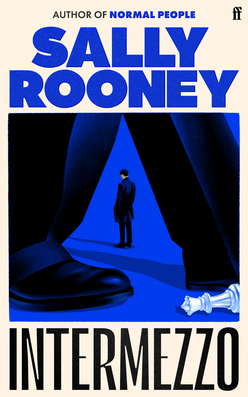
I started reading this book -and I can no longer remember why I did – with some quite strong prejudices about Sally Rooney’s work, which, I fear, may have largely been based on the envy of an only very modestly successful writer for a very successful writer indeed. I would sum up my prejudices by saying that my impression, from reading reviews etc, was that she wrote about very attractive, very intelligent people having very exciting, if complicated, sex lives – and that her books were a kind of posh, elegant fantasy world for folk who’d love to imagine themselves as part of a sophisticated elite.
Well this is a book about very attractive, very intelligent people having very exciting, if complicated, sex lives, but, as it turned out, I came to like it a lot. I thought it a bit sugary (that was the word that came to mind), but I ended up forgiving it even that.
To deal with the ‘sugariness’ first. What I meant by that is that the book presented what seemed to me a very idealised view of romantic and sexual love. The characters are not only good looking and intelligent, but also exceptionally emotionally intelligent: extremely honest with one another about their own feelings, extremely willing to accomodate the feelings of others. Things happen which seemed unlikely, and sometimes the book read to me like a sexual fantasy (and a male sexual fantasty at that) rather than a depiction of the real complications and ambivalences of sexual/romantic relationships between men and woman.
For instance, Peter, the older of the two brothers round whom the story is built, has a girlfriend, Naomi, nine years younger than himself, who says things to him like ‘do whatever you like to me.’ (I’m not aware of the reception this book has received but I’m willing to bet that people have found this ‘problematic’). Also, Peter agonises throughout the book about being torn between the very beautiful, intelligent and extremely sexually available Naomi and his very beautiful and intelligent ex-girlfriend Sylvia, who he still loves deeply, and is still loved by, but who ended the relationship with him after a mysterious accident which prevents her from having penetrative sex (though she does still give him a blow job) – but in the end (spoiler alert), he ends up being able to maintain his relationship with them both, the two of them having become friends. This seemed quite generous on their part, though certainly nice for him.
Meanwhile Ivan, the younger brother, who is a 22-year old semi-professional chess player, very handsome, very smart, but shy, naive, gentle, and sexually very inexperienced, manages to seduce Margaret, the very nice and extremely beautiful 36-year-old director of an arts centre where he’s been booked to play ten simultaneous exhibition games. And he does so a matter of hours after meeting her – which, speaking as a recovering shy, naive, sexually inexperienced young man, feels rather unlikely, though it is, to my inner naive young man, without doubt a very alluring fantasy.
So by sugary I mean, I suppose, idealised, simpler than reality, a fantasy… But I forgave the book this because I decided that in one way or another, a novel has to be simpler than reality. However long and complex, a novel is a truly tiny thing compared to the real world, and it is, in a way, like a scientific experiment which holds some factors constant, in order to isolate and explore others. Movies have to simplify life in the same sort of way, and the protagonists of any cinematic love story are invariably much better looking than the average human being, and usually much more graceful and charming in their manners also (if only we all had scriptwriters to prepare our romantic encounters for us!). But this may actually be necessary (or so I thought) because a film, which is much shorter than a novel, has only a brief time in which to tell the story. We need to understand the attraction pretty much from the off, and a good way of achieving this is to cast very beautiful and charming men and women actors, since we can all immediately see the attraction of good-looking and charming people. (I’m almost 70, and I’m still instantly moved -disturbed even, sometimes- by female beauty.)
Also ‘sugary’ is a synonym of ‘sweet’ – and sexual love between men and women is sweet. It just is (for biological reasons, of course, as Rooney herself notes, but then all love has a biological basis), as is the trace of it that exists, I think, at least to some small degree, in most warm relationships between heterosexual men and women, even when these relationships aren’t, and will never be, sexual. It can go badly wrong, it can lead to all kinds of misunderstandings and even to horrible abuses, but it is, in itself, sweet -and even the horrible things that happen are often due to people craving that sweetness and not knowing how to get it, or not knowing how to hold onto it.
What I ended up liking about this book is this. Books about sexual love are of course two a penny -it is probably the single most common driver of human stories – but usually they take sexual attraction and sexual love as a given, a thing that everyone understands and recognises. In this book, it seems to me, Sally Rooney doesn’t do that. She attempts to unpack sexual love, and look at it in an almost naive way, as if encountering it for the first time, even though her prose is itself polished and sophisticated. I think that’s what writers should do with human experience: make us see things we think we already know as if they were new and fresh. What’s more- and this is something that I think is relatively unusual for a woman writer- she does this as much from a male point of view as a female one, both with equal sympathy.
I’m not going to attempt to describe or discuss the whole book here. There are other themes in it. For instance, both brothers have recently lost and are grieving their much beloved father. (This barely touched me at all, and didn’t seem to me the part that really interested the author either, but I could well be mistaken in that -I didn’t grieve my own parents and, when other people grieve theirs, I think ‘you lucky bastard’, so it may just be that the grief had no resonance for me.) The relationship between the brothers is very well done, I thought, but isn’t what I want to write about. And, while the book deals with the love lives of both brothers, it is the young naive brother, Ivan, that I thought was done best, and/or identified with most easily, so I’ll just talk about him and Margaret here (Margaret, as well as the brothers, is herself a viewpoint character, older and more experienced than Ivan but almost as much of a beginner as him in the strange new territory of a relationship with a man so much younger than herself).
What drew me into the book was the original encounter between Ivan and Margaret, which begins some twenty pages in. The chess club which is hosting the exhibition event, almost all of whose members are male, is putting together the room for the simultaneous games when Margaret, the manager of the venue, enters. She is a very beautiful woman and the men all react to this fact -they have been busy moving tables about and suddenly start to do so in a more ‘manly’ fashion, while pretending not to notice her at all. Ivan thinks about what it must be like to be a beautiful woman, and how tiresome it must be to have men constantly reacting to your beauty, and not just dealing with you as a fellow human.
But he is reacting to it too. He makes a joke and she laughs, and ‘the feeling of making her laugh is so nice that he also starts to smile’. (I love the use of the word ‘nice’ here.) She looks at him in a friendly way and he realises that ‘it would be creepy of him to read too much into her friendly looks, since she’s literally at work right now, being paid to stand here talking to him’ (‘literally’ is another great word, a young man’s word). But at the same time he is obviously hoping or wishing he could read more into those friendly looks because otherwise he wouldn’t need to have that thought. He starts to think about how lovely it would be to kiss her. When the captain of the chess club – Ollie – observes to him that she’s a ‘nice woman’ he wonders if, when men say things like that, it’s really a coded way of saying she’s attractive, and wonders whether Ollie also experienced ‘a certain captivated feeling’ when she looked into his eyes.
And then he starts to wonder, given that he can see how tiresome it must be to have to deal with unwanted sexual comments and invitations if you are an attractive woman, how exactly it is possible for men and women, ‘to reach a mutually agreeable situation without one person making an advance on the other which may turn out to be unwanted’. Somehow other people seem to manage it – Ollie himself, who is ‘small and portly’, is wearing a wedding ring – but how?
Margaret is thinking in a similar way when everyone goes to a bar afterwards. She uses the word ‘passionate’ when talking to Ivan – ‘it’s always interesting to hear people talk about the things they’re passionate about’- and then regrets it, because she feels it is a sexual word, and she knows that, without deliberately meaning to, she used it because she is aware that ‘when he looks at her… his eyes communicate: I know that you are a person with desires, and so am I, even if I am helpless to do anything about this knowledge.’ She thinks how she mostly goes through life ‘interacting pleasantly with the people around her… never thinking… about the profound and carefully concealed sexual personalities of others.’
And when they do reveal their sexual selves to each other, there is the rest of the world to deal with. Ivan has to deal with his brother’s disapproval (hypocritical though it is, since Peter’s girlfriend is the same age as Ivan) and Margaret has to deal with the fact that the small community where she lives will judge her as a cradle snatcher – and perhaps rightly so, she thinks: perhaps she really is dragging Ivan away from the happier life he could lead if she let him find a girlfriend his own age. She’s aware too that, though she is separated from her abusive and alcoholic husband, they are still married, and many will judge her because of that also, and she knows that you can’t just dismiss other people’s views as irrelevant because other people are the medium in which we live.
I loved the kind and tender way the book dealt with all of this, certainly ‘sweet’ (let’s use that word instead of ‘sugary’), and certainly simpler than real life, but still trying to engage honestly (or so I felt) with the way life really is.
