“Sense of wonder”

Most people who read or write science fiction identify a “sense of wonder” as part of the original appeal of the genre.   This was certainly true for me.  Reading SF as a teenager with an as yet unjaded palette, I enjoyed the almost spinetingling sense of strangeness that it evoked.

I think one of the things science fiction can usefully do, is remind us that, outside the tiny tiny realm which has come to seem ordinary to us  as a result of habit and familiarity, this is a very strange universe.   (Science fiction has a particular way of doing this, but you could argue that all artistic-type activity ought to be aimed at tearing away the veneer of ordinariness.)

Science fiction can however contribute itself to a kind of dulling and deadening:  a kind of inflationary process exists which is in danger of debasing the currency of wonder.   The first time you see or read about a gigantic space ship, for instance, it inspires wonder.  When you have seen the same thing repeated over and over again, it grows tedious – and just making the spaceship even bigger does not help.  As Ian Sales says:  ‘Scale is not sense of wonder, and a lot of sf confuses the two.’    I wonder if it is possible that a failure to understand this fact has led to the decline in prestige and popularity of SF?

This is a related, but not identical point, to that made by the proponents of Mundane SF who propose that science fiction ought to be more scientific, more committed to the world that actually exists, and confine itself  to futures and technologies that might actually occur.   Faster-than-light-travel and galactic empires, are really just escapist fantasies, on this argument.  They will almost certainly never happen, and to write about them as if they were possible futures is perhaps to downplay the uniqueness and importance of our home on Earth, possibly dangerously so.

I go along with the spirit of this argument, but not entirely with the letter of it.   I agree that it is important that SF should connect with the world we actually inhabit and I am not interested in SF that doesn’t (not just for reasons of principle but also because I find it very tedious).   But sticking literally to what is actually possible is not the only way of reflecting and exploring the world we  live in, and not only SF but all branches of literature work by taking some liberties with the literal truth.

Literature and Science Fiction

Science fiction writers are often touchy about snobbery directed against their genre, the assumption that because something is set in the future, or has robots in it, or is set on another planet, it can’t be ‘serious’ literature (unless, of course, it’s written by someone who is already known for ‘serious’ literature, like Lessing or Ishiguro).   See recent observations by Philip Palmer and Stephen Hunt.

I share this irritation.  Of course science fiction can be badly written, poorly characterised etc etc but so can historical fiction.  That doesn’t mean we dismiss War and Peace because it happens to be set in the past.  Of course science fiction can be light-hearted, intended as a diversion and nothing much more, but this is undoubtedly true too of a lot of romantic fiction, and it doesn’t make us dismiss Jane Austen just because her novels fall into that bag.   And of course science fiction involves making stuff up, and indulging the reader in imaginary worlds, but so does The Tempest and  Midsummer Night’s Dream.

The tools of science fiction can be used for a lot of purposes (like a pack of playing cards that can be used for many different games).  I use them to write, as originally and interestingly as I can, about things that matter to me, and strike me as important, which I believe is what Tolstoy, Austen and Shakespeare did too.   I don’t know if the end result is literature and, assuming that this is even a meaningful question, it would be for others to judge not me.  But it’s annoying that there are a lot of people out there who’d be happy to make that judgment  without even reading what I have to say.

Us from the future

I’ve read a couple of books lately about the Tudor era: Anna Whitlock’s book about Mary Tudor, and Chris Skidmore’s book about Edward VI (Edward and Mary being a brother and sister under whose reigns first Catholics and then Protestants were persecuted).   I also recently saw the film The Other Boleyn Girl, which I enjoyed, and seemed true to what I had read about the Tudor world-view, though I gather its not that strong on historical accuracy.

I was struck by all of these – as I also am when I see Shakespeare plays – with how different people’s world view was.  The acceptance of extraordinarily cruel punishments.  The killing of political opponents as more or less standard procedure.   The way that family duties flow upwards (children to parents) rather than downwards, and the way that the needs of a family’s ‘head’ trump the wishes of individual members.  The strange mix of a very frank and earthy way of talking about sex with strict rules about marriage and inheritance.  The massive double standards about chastity and sexual fidelity.  The seemingly cynical manipulation of religion oddly combined with a faith so intense that people are willing to die horribly for it…

The Tudor world-view  seems strange and even perverse from the perspective of now, and I wonder what about our own present western world view will seem equally strange and perverse from the future.  My guess is that we will be seen as having elevated the human individual to an odd degree: with individual freedom of choice as the supreme good, or in any case held up as such.  (For of course just like the Tudors we are capable of holding something up as supremely important but not necessarily treating it consistently as such in practice) .

I’m not very well-read in these matters but I guess this sanctification of individual choice is a product of capitalism.   The customer is always right.  (Again, as a matter of theory and rhetoric, though not necessarily in practice).  In the modern UK,  even the citizens of the  state are constructed as its customers, always justifiably aggrieved by the poor service, and always deserving of a better one.   In Tudor times, from what I can see, the idea of ‘citizens’ as customers of the state would have simply seemed bizarre.  Rather they would have been component elements within it, each one supposed to play a part, like cells in the body politic.

I guess there are other ways of seeing this relationship between individual and society, perhaps as yet inconceivable.

Christopher Priest: Inverted World

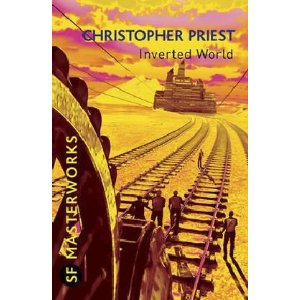
Feeling that I would like to steep myself a little more in the history of the genre in which I write,  I’ve been buying books in Gollancz’s SF Masterworks series, and have just finished this one which I had never come across before.   The cover sold it to me, and more than most covers do, sums up what the book is about.

Priest’s own website includes a scathing review of this book by Martin Amis (complete with a spitefully gratuitous spoiler),  pointing out the wild implausibility of the story.   Amis also suggests that a ‘courteous editor’ would have reduced the first 100-odd pages to more like 20.

It’s true that there are a lot of holes in the story.  It isn’t plausible and, even looked at within its own terms, there are obvious questions left unanswered (why, when the inhabitants of the city are constantly interacting with the people around them, has no one in the past 200 years ever thought of asking the locals where they actually are?)

But the central image is incredibly compelling.  A city is perpetually being very slowly hauled along railway tracks that must be laid ahead of it, and then taken up again after it has passed.   It must keep moving forward to escape annihilation which is never far behind it.   Surveyors go out ahead of it (or ‘up future’ as the characters in the story call it, for they conflate distance and time and measure their lives in miles) to try and work out the best route to follow.    Others ride out from the city to recruit locals to labour for them… and to bear them children, for the city does not produce enough girls of its own.

Amis’ comment about the length of the first 100 pages misses the point.   The joy of this book is this central image.  It’s very rich in metaphorical possibilities and we need time and the accumulation of detail to let us savour it,  let it soak in, allow us to inhabit it.    One Amazon reviewer mentions that the book prompted a very vivid dream.   Yes, this city on rails does have a feel that is like the odd places we come back to again and again in our dreams, full of meaning, yet not amenable to simply being decoded into a single, simple message.

css.php