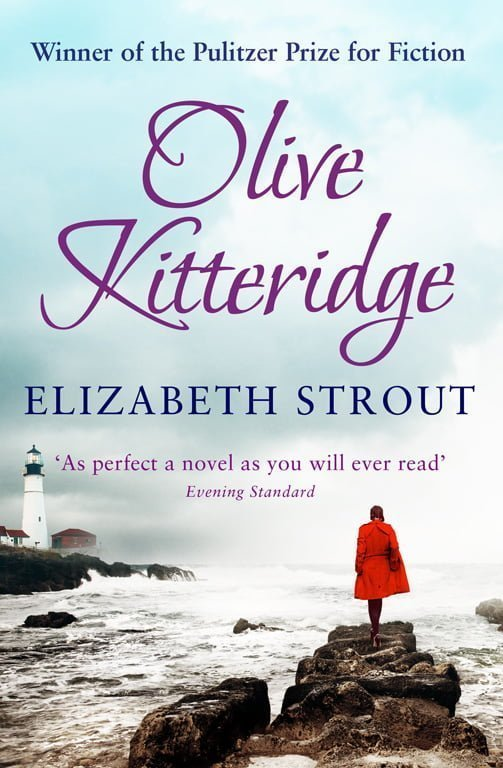
‘Most of us are sad,’ doesn’t actually come from this book. It’s a song by the Eagles, who I don’t even particularly like. But it’s a good line (as are the later lines ‘We have brought our children here/ Who can save them now?’) and it has just come into my mind as an alternative title for this rather bleak book:
Sometimes… Olive had a sense of just how desperately hard every person in the world was working to get what they needed. For most, it was a sense of safety, in the sea of terror that life increasingly became.
It was too bleak for me to say that I enjoyed it exactly, but I admired it. It did me good, like bitter medicine.
Opinion seems to be divided as to whether Olive Kitteridge is a novel or a short story cycle. Certainly in formal terms it is a series of stories which could in principle be read on their own. Some of them concern characters who you don’t meet elsewhere in the book, and on occasion information is repeated, so as to make a story self-contained, even when it is sufficiently memorable that you wouldn’t normally bother to recap it in a novel. But the whole book deals with a small community on the coast of Maine, and the main character is undoubtedly Olive Kitteridge herself. Sometimes seen through her own eyes, sometimes through the eyes of others, and sometimes only in the background, the book tracks her life from middle age to her early seventies. So I’d say it’s a novel that the author has chosen to write as if it were a series of shorts, the big advantage of this being that this way it doesn’t need a plot. Plots are great for keeping people going through a book but they are not realistic and that’s always a drawback in a supposedly realist novel.
Olive, a big, intelligent woman, and a maths teacher by profession, is one of those people who others describe as ‘formidable’ or say of them that ‘they don’t suffer fools’. She has a sharp eye and can be compassionate but -and this reminded me of my late mother – she can’t abide small talk, and can be cruelly self-indulgent in the sense that she often feels free to express feelings without much regard for the impact on other people. Also like my mother, and like a lot of blunt people in my experience, bluntness is something she can dish out but can’t necessarily take. She is devastated when she learns indirectly that her adored son found her extremely difficult as a parent, and even more devastated when he finally feels strong enough to explain this to her face himself, and to refuse to be cowed by her manipulative emotional response.
(Reading this part was painful for me. I’m someone who feels his parents burdened him with a lot of difficult stuff which has taken a lifetime to begin to unravel, yet I’m now increasingly aware that I placed similar burdens, sometimes even the same ones, on my own children. I’m grateful that they still hang in there and make me feel like I’m appreciated in spite of everything, something which Olive’s son doesn’t feel able to do. Poor Olive. Poor him.)
The book is particularly good at depicting all that goes on beneath the social surface of the world. There are obvious things like secret sexual liasons, and peculiar things like Olive deliberately stealing odd shoes from her daughter-in-law’s wardrobe (because she’s jealous of her, thinks she’s too sure of herself and wants her to feel some bewilderment and self-doubt), but there are also many feelings that barely get outwardly expressed, if at all, but are nevertheless there. Olive’s pharmacist husband Henry, for instance, has a quiet crush on his much younger assistant, and, when her husband dies, has fantasies about leaving Olive and marrying her. Olive herself has a passion for a man called Jim, and is beside herself with grief when he dies in a car crash. They sense each other’s feelings for these people outside their marriage, but they stay together.
Then there are the sorts of feelings that people have about others that they’ve known for so long that they feel they’re able to see through them. These are a particular feature of long marriages and I think this book is particulary good at depicting marriages as tangles of complicated emotions, rather than the straightforwardly positive emotions which I suppose we are all hoping for at the outset – emotions so contradictory that they often cancel each other out. (Olive not even bothering to look at the flowers Henry has brought home for her.) Henry Kitteridge is a much-loved member of his community and everyone thinks he is a ‘doll’, but to Olive his niceness is a kind of performance which he puts on so as to have the reassurance he needs about his own likability.
(People who are not people-pleasers and like to think of themselves as tough are often suspicious in just this kind of way of the overt vulnerability of others and the ‘niceness’ of people-pleasers, but they don’t always see that being ‘formidable’ is also a performance, also a defensive strategy. Olive herself glimpses this on the penultimate page of the book when the fleeting thought comes to her that she hates scared people because she hates the ‘scared part of herself.’)
This book is miles away in tone from the sweet, sensuous and idealised depiction of sexual love in the last book I wrote about here (Intermezzo), but in the end it comes, in a way, to a similar place. When (spoiler alert), Henry dies after a lengthy period in which he can no longer talk and may not even be sentient, Olive’s life feels unbearably empty and she longs for death herself. She meets a man who has also been widowed and has been feeling the same sort of despair (he’s also got a daughter who he’s managed to completely alienate). He and Olive feel their way hesitantly towards a new relationship in spite of the many obvious differences (the man is a Republican for one thing, and voted for George W. Bush). There’s no time left to wait for a better match. ‘They were here, and her body -old, big, sagging- felt straight-out desire for him.’
